Tampilkan postingan dengan label yellow. Tampilkan semua postingan

Kamis, 24 Maret 2016

Yellow boat 4 FPV camera view Purau New Zealand 2 1 14


Yellow boat 4 mostly Hobby King bits balsa epoxy fiber glass hull 
http://kiwitricopter.blogspot.co.nz/2012/09/3-hour-yellow-boat.html


Twin Turnigy 450 Series 3800KV Brushless Outrunner Helicopter Motor
RPM: 3800kv
Max Current: 35A
Max Power: 365W

2 X HobbyKing 30A BlueSeries Brushless Speed Controller with shared enlarged air cooled heatsink with an 30mm fan
Cont. Current: 30A
Burst Current: 40A
http://www.hobbyking.com/hobbyking/store/uh_viewitem.asp?idproduct=13429&aff=652823


coupled to modified NQD jet drives with flex shafts and custom 3 blade impellers 

ZIPPY Compact 2700mAh 3S 25C Lipo Pack
Capacity: 2700mAh
Voltage: 3S1P / 3 Cell / 11.1V
Discharge: 25C Constant / 35C Burst
Weight: 203g (including wire, plug & case)
Dimensions: 137x15x44mm
Balance Plug: JST-XH

http://www.hobbyking.com/hobbyking/store/uh_viewitem.asp?idproduct=21349&aff=652823

Purau
https://www.google.co.nz/maps/preview#!q=Purau%2C+Canterbury&data=!4m15!2m14!1m13!1s0x6d322f14fc09c6a3%3A0x500ef868479e4b0!3m8!1m3!1d338144!2d175.3085223!3d-37.6203018!3m2!1i1366!2i642!4f13.1!4m2!3d-43.6390402!4d172.7489035

Yellow boat 4 FPV camera view Purau New Zealand 2-1-14 from nickatredbox on Vimeo.


Read More..

Sabtu, 19 Maret 2016

Someone else building a Yellow boat in Blue Coroplast

Someone else  building a Yellow boat in Blue Coroplast

Blue Boat 1 a single piece of Coroflute


Yellow boat 1 and 2

Yellow Boat 3 

Yellow Boat 4 Balsa ply Epoxy Fiberglass tape


Read More..

Sabtu, 12 Maret 2016

Yellow boat 4 Arduino code with HK TR6 A V2 RX PPM interface


Im lowering the top BTW

The build here


The engineering in the boat the cooling fan circulates air blowing it out between the motors. This wee fan moves lots of air on 7.4 Volts


Arduino Inputs from RX

Ch3   Throttle                       Arduino pin 4
Ch1   Steering                       Arduino pin 5
Ch5   Throttle limit                Arduino pin 6
Ch2   Steering on Throttle       Arduino pin 7

Arduino analogue inputs

Anin 0  Ambient temp sensor                      Anin 1  Hall effect current sensor

Arduino outputs

Pin 8    Left jet
Pin 9    Right jet
Pin 10  Cooling fan speed
Pin 11  Steering

Mixing of the outputs

    
  //SteeringBias
  
  int SterringOnThrottle = (long)map((int)ch4v, 1500, 1100, 0, 1000); 
  
  if(SterringOnThrottle < 0) SterringOnThrottle = 0;
  
  SteeringBias = (long)map((int)ch3v - (int)ch3vWOZ, 0, 1000, 0, SterringOnThrottle); 
    
  int SteeringAngle = (long)map((int)ch3v, 1100, 1900, 1000, 2000);
  
  //Limit fan speed for 11.1 V
  FanSpeed = map(FanSpeed, 1100, 1900, 1000, 1500);
  
  //Update the outputs
   
  Servo1.writeMicroseconds((int)Throttle - (int)SteeringBias);
  
  Servo2.writeMicroseconds((int)Throttle + (int)SteeringBias);
     
  Servo3.writeMicroseconds((int)FanSpeed);
   
  Servo4.writeMicroseconds((int)SteeringAngle);


The cooling system


The fan is a 27 mm EDF should keep the air moving with a 10A ESC


There is a big heatsink and fan on the 30 AMp ESCs


Read More..

Sabtu, 06 Februari 2016

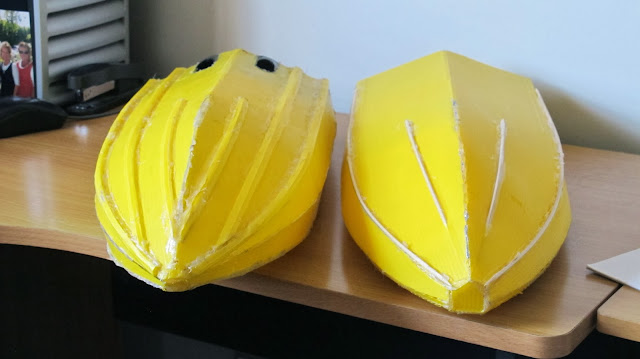
Wood and fiberglass hull like yellow boat


Based on yellow boat plans different deck 390 Grams as shown 
Also Ply fiberglass epoxy catamaran build log

Yellow boat 3 http://kiwitricopter.blogspot.co.nz/2012/12/yellow-boat-3-power-test-scratch-built.html

Fit out http://kiwitricopter.blogspot.co.nz/2013/12/mad-man-yellow-boat-2-x-turnigy-heli.html

Sea run a Purau http://kiwitricopter.blogspot.co.nz/2014/01/yellow-boat-4-fpv-camera-view-purau-new.html

Another run at Motunau http://kiwitricopter.blogspot.co.nz/2014/01/yellow-boat-4-motunau.html

Evo 2 http://kiwitricopter.blogspot.co.nz/2014/01/yellow-boat-4-revised-powertrain.html

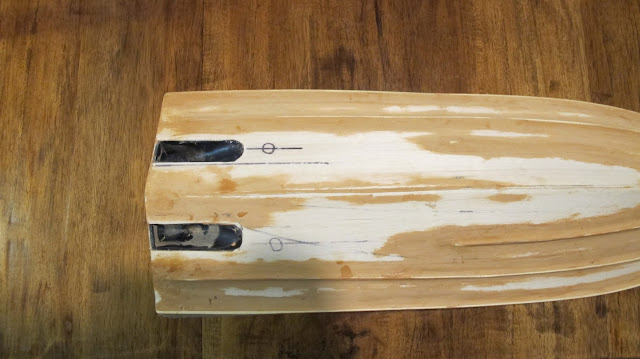
Glass and epoxy inside balsa ply, will epoxy the outside too. Its very strong with builders fiberglass tape and epoxy 


The motors will be mounted further forward on a cooled plate 


Spray rails are bamboo barbecue skewers and wood filler  


Will be powered with 2 of the following


P2632 Brushless Outrunner 3800kv


The Arduino code will be the same as I ran in the Catamaran I may add differential thrust with steering angle as its a twin


#include  

int ch1 = 4;
int ch2 = 5;


unsigned long ch1v;
unsigned long ch2v;


unsigned long RightLeft = 0;
unsigned long UpDown = 0;
long Trim = 0;
long Throttle = 0;
long Cooling = 0;
long PumpSpeed = 0;


Servo Servo1;
Servo Servo2;
Servo Servo3;
Servo Servo4;

#define MAX_CHAN 8
int AnIn[MAX_CHAN] = {0, };

unsigned long PPMtout = 20000;

char buf[300] = {0, };

long mS = 0;


 void setup() {
   
  
  Serial.begin(115200);

  
  pinMode(ch1, INPUT);
  pinMode(ch2, INPUT);

  
  Servo1.attach(8);
  Servo2.attach(9);
  Servo3.attach(10);
  Servo4.attach(11);
  
}

void loop() {
  

  AnIn[0] = analogRead(A0);
  AnIn[1] = analogRead(A1);
  AnIn[2] = analogRead(A2);
  AnIn[3] = analogRead(A3);
  AnIn[4] = analogRead(A4);
  AnIn[5] = analogRead(A5);
  AnIn[6] = analogRead(A6);
  AnIn[7] = analogRead(A7);
  
  /* RAZU-2 Six turn
  This device has a gain of 55mV per amp giving a 36 Amp working range, 
  and a resolution of 11.3777 mA per bit with the maximum output at 5 volts 
  which is 1024 bits in the Arduino. By the way I should point out that 
  these devices on a 5 volt rail will sit around 2.5 volts with no current 
  flowing, so at a 2 Volt delta the out put should be around 4.5 V
   */
   
  mS = micros();
  
  //Get PPM from each RX channel  
  noInterrupts();


  ch1v = pulseIn(ch1, HIGH, PPMtout);//Throttle
  
  if(ch1v > 0)
  {
    ch2v = pulseIn(ch2, HIGH, PPMtout);//Imax

  } 
  else//Fail safe
  {
    ch1v = 1000;
    ch2v = 1000;    
  }
    
  interrupts();
  

  //ALLOW INTERRUPTS BEFORE UPDATE SERVOS
  delayMicroseconds(2000);


  //Calculate motor amps
  long Motor_mA = ((long)(AnIn[1] - 512) * 11.0f);


  int Tmax = (int)ch2v;
  
  //Set max throttle
  Throttle = (long)map((int)ch1v, 1000, 2000, 1400, Tmax); 
    
    
  //Calc amps
  long Amps = (long)map((int)Motor_mA, 0, 36000, 0, 36); 


  //Calculate cooling temp RTC on AnIn[0]
  int cerr = ((int)600 - (int)AnIn[0]); 
    
  //Integrate temparature
  Cooling += cerr;
   
  if(Cooling < 1000) Cooling = 1000;
  else if(Cooling > 2000) Cooling = 2000;
    
  //Use the temperature integrator plus the motor current 
  //36 Amps gives us 360 bits
  PumpSpeed = (long)Cooling + (Amps * 10);


  //Update the outputs
   
  Servo1.writeMicroseconds((int)Throttle);
     
  Servo2.writeMicroseconds((int)PumpSpeed);


  long Cyc_mS = (micros() - mS);
  

  //ALLOW SERVOS TO UPDATE BEFORE INTERRUPTS OFF
  delayMicroseconds(18000 - Cyc_mS); 
  
  Cyc_mS = (micros() - mS);
  
  sprintf(buf, "ch1v_Tmax:%d,ch2v_Imax:%d,Throttle:%d,AnIn[0]:%d,AnIn[1]:%d,CoolingError:%d,Cooling:%d,Imax:%d,MotorAmps:%d,Cyc_mS:%d", (int)ch1v, (int)ch2v, (int)Throttle, AnIn[0], AnIn[1], cerr, (int)Cooling, (int)Tmax, (int)Amps, (int)Cyc_mS );
    
  Serial.println(buf);
  
  
  /*
  char incomingByte = 0;
  
   // send data only when you receive data:
  while (Serial3.available() > 0) {
    // read the incoming byte:
    incomingByte = Serial3.read();
    
    Serial.print((char)incomingByte);
    
    delayMicroseconds(1000);
    
    if(incomingByte == 13) break;
  }
  
  Serial.println( );
  */
    
}

Read More..